
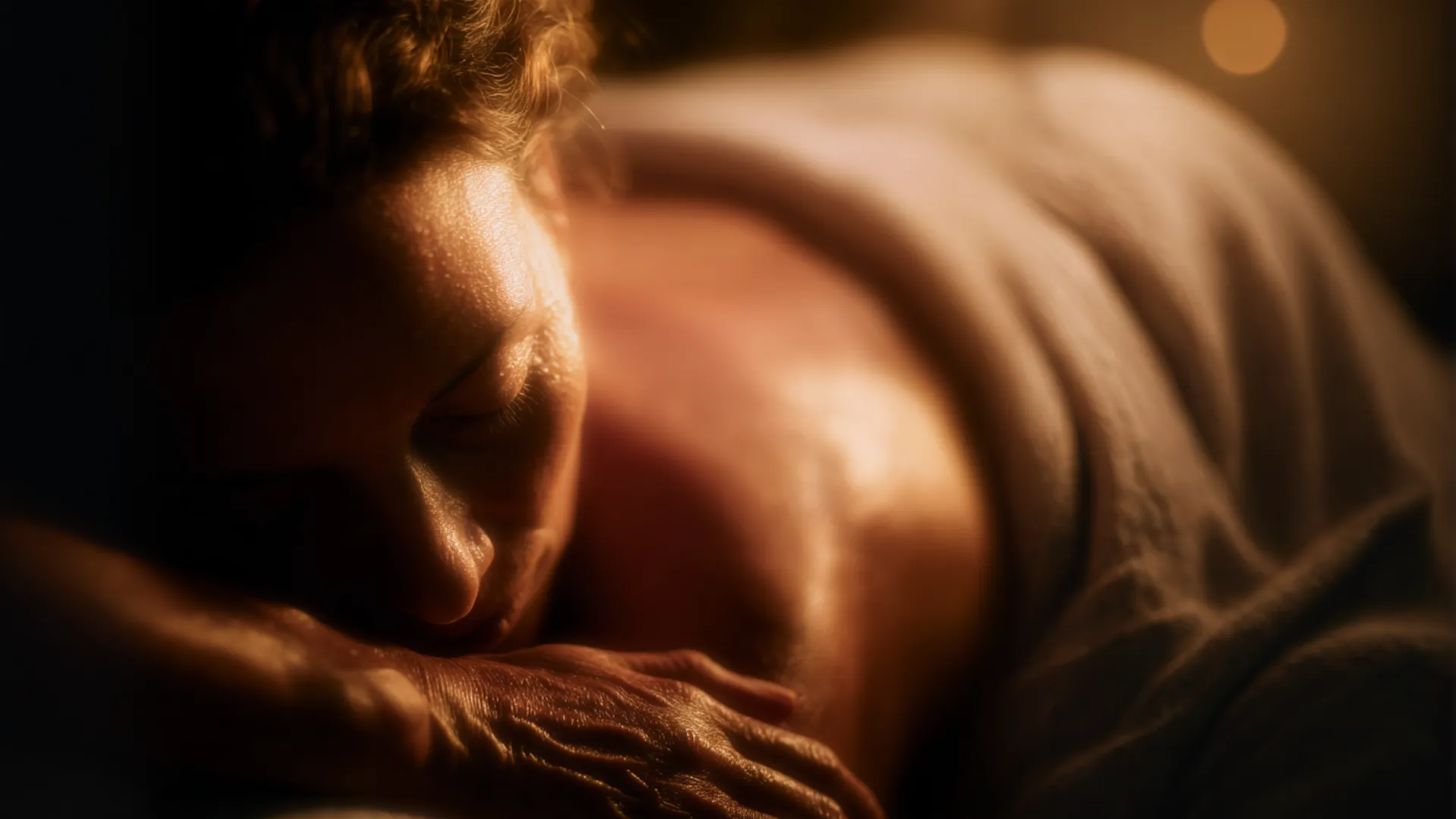
What this work is. And what it is not.
Sacred Touch is a consent-led, reverent somatic bodywork practice for women who are ready to stop understanding their body and start inhabiting it.
There are wounds the mind can name but not complete.
The mind can understand why the body went quiet. It can trace the pattern, tell the story, forgive and reframe and integrate.
But the body keeps its own calendar.
It releases in the presence of experience. Not explanation alone.
Some of what the body holds was shaped in relationship. In moments when safety was absent, when the body learned that staying alert was safer than softening. That layer is not reached by thinking about it differently.
What a body sometimes cannot give itself is the direct experience of being received by a safe, attuned, boundaried other. A steady presence, clear pacing, and unhurried touch create a specific kind of input the nervous system recognises. Not as an idea. Somatically. And when it recognises it, something held under long effort can begin to release.
This is not a promise. It is a description of the direction.
The hands are trained.
The touch draws on two living traditions. From a Polynesian bodywork lineage, a slow, whole-hand contact that meets the body as one continuous field rather than a set of parts. From an Eastern esoteric lineage, an intimate knowledge of the body's subtle map: the meridians and vital energy the Taoist tradition works with, and the marma, the body's vital points, where tension and life gather. One tradition holds the whole field. The other reads the precise points within it.
Devotion is the posture. Lineage is the craft.
Thomas returns to both teachers regularly. This is training he keeps deepening, not a certificate he holds.
What the work relies on is not technique alone. A body softens when it registers safety, not when it is told to relax. Steady presence, clear pace, unhurried contact: the nervous system reads these as input, and begins to set down a guard it has held for a long time.
What happens in a session.
You arrive into a private space.
The room is warm, 24 degrees, prepared before you arrive. The session begins with a conversation over tea. Thomas describes what the session involves, and you can name boundaries, preferences, questions, or simply say: I do not know what I need yet. That is enough. The scope of a session is settled before you arrive; the conversation restates it, so nothing is assumed or left unclear. Then, before any touch, a short guided breathing and a quiet practice of arriving in the body: time for the mind to step back and for the breath to find its own depth.

You undress; you remain covered.
When you are ready, you undress. You may keep your underwear on if you wish. You are covered with soft linen. Your genitals stay covered for the whole session, always. Whether your breasts stay covered is your choice, settled in the conversation before you undress, never on the table. The linen moves with the work; what is not being worked on stays covered. You may cover up again at any point, without giving a reason. Thomas remains clothed.

The touch is slow, attentive, and responsive.
The bodywork moves over the whole body, unhurried, with warmed coconut oil, vegan and food grade, and essential oils. It begins on the back. Then the legs and the feet. You turn, and the work moves to the abdomen, the chest and arms, the hands, and last the head and face. Long, slow strokes, carried by body weight rather than force. Music chosen for this work runs quietly under the bodywork; around it, the room stays silent. A session includes no contact with your breasts and no contact with your genitals. Uncovered is not the same as touched.
The session follows your body's pace. You may speak at any time. You may ask for more, less, stillness, a pause, or a change. You may stop the session at any moment.

Afterward, there is time to return slowly.
Near the end there is a stretch of complete stillness. Hands resting, or not touching at all. Nothing done. A quiet close gathers the session, then the return: water, warmth, time to sit up in your own rhythm. No debrief unless you want one. The return belongs to the session; nothing in it is rushed.
What returns.
Not always as thunder.
Sometimes the body returns in a single sentence. Sometimes:
- Sometimes As breath.
- Sometimes As the weight of the body finally meeting the table.
- Sometimes As warmth in a place that had gone quiet.
- Sometimes As tears that do not need a story.
- Sometimes As the simple relief of not having to hold anything.
The body may remember how to soften without disappearing. How to receive without owing. How to feel without bracing. How to be touched without leaving itself.
This is not a promise of outcome.
It is the direction of the work. A return to your body as home.
If this is what your body has been waiting for.
Request your sessionA fully consent-led space.
Sacred Touch is professional, consent-led, reverent somatic bodywork.

Its depth comes from presence, not ambiguity. The clarity of scope is what makes the depth possible.
This practice is built on explicit consent, clear boundaries, and the kind of ethical clarity that allows your nervous system to genuinely release.
Nothing is assumed, and nothing continues without your comfort. If anything feels like too much at any moment, the session stops completely. It does not continue until you choose what happens next. Your discomfort is never something to push through. It is something to listen to. Your pace governs everything.
A body does not soften because it has been told it is safe. It softens when it no longer has to watch.
If you need more than this to feel safe enough to arrive, you are welcome to reach out before booking. Questions about scope, structure, and practice are not obstacles to this work. They are part of it.
Choose the space your body is asking for.

Every session includes
- The conversation over tea before anything begins
- Guided breathing to arrive, before any touch
- The room at 24 degrees, prepared before you arrive
- Warmed oil
- The full bodywork, unhurried
- A stretch of stillness near the end where nothing is done
- And time afterwards that no one will rush